
A Subscript Alternative for QuickBooks-Based B2B SaaS Teams
Subscript is a billing platform with revenue recognition, collections and analytics built in. TrueRev is built for B2B SaaS finance teams that keep QuickBooks Online and want revenue recognition, deferred revenue, contracts and SaaS metrics without adopting a broader billing platform than their requirements call for.
.svg)
.png)
.png)

.png)
Revenue recognition for finance, operations and sales
Subscript covers billing, collections and revenue recognition in one system. TrueRev adds revenue recognition, deferred revenue and SaaS metrics around the QuickBooks Online setup your team already uses.
For Finance Teams: Revenue Recognition on Top of QuickBooks
For controllers, CFOs and accounting managers who want auditable revenue schedules without running them in spreadsheets.

For Operations: Contract Changes in One Place
For operations leaders who manage renewals, upgrades and cancellations.

For Sales and Revenue Teams: One Set of Numbers
For revenue leaders who need MRR, ARR and churn figures that match what finance reports.
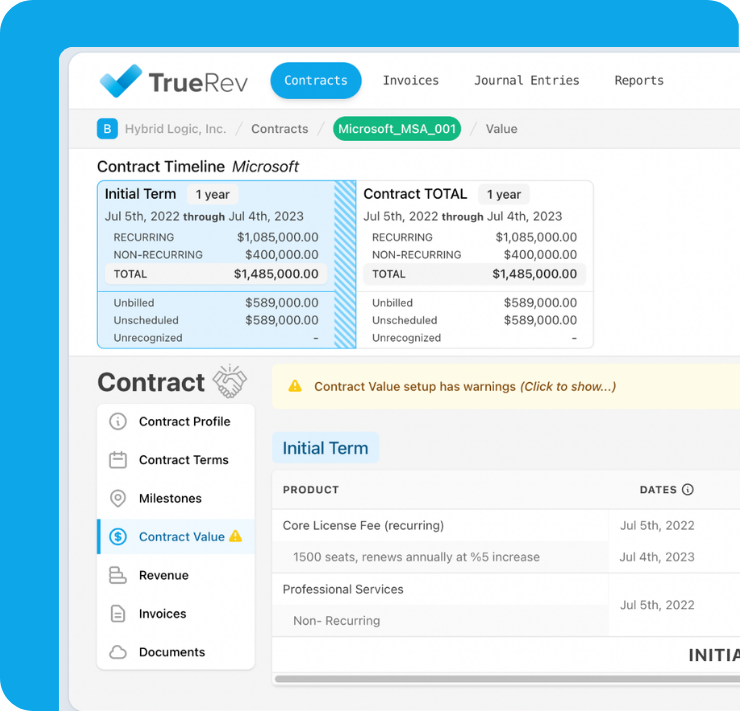
TrueRev vs Subscript: What is the main difference?
Both platforms support revenue recognition and SaaS metrics for B2B SaaS companies. The bigger difference is platform scope. Subscript combines billing, accounts receivable, collections, revenue recognition and analytics in one platform. TrueRev focuses on the finance layer: revenue recognition, deferred revenue, contracts, scheduled invoicing, journal entries and SaaS metrics around QuickBooks Online.
| Area | TrueRev | Subscript |
|---|---|---|
| Primary focus | B2B SaaS financial operations around QuickBooks Online | B2B SaaS billing with A/R, revenue recognition and analytics |
| Revenue recognition | Core product, with schedules built for ASC 606 | Included with Subscript Billing at no extra charge, per Subscript |
| Deferred revenue | Supported | Listed on its G2 profile; confirm depth in a demo |
| ARR / MRR / SaaS metrics | MRR, ARR, bookings, churn, retention, expansion revenue | ARR, CARR, LTV, CAC, NRR, GRR and 54 other metrics |
| QuickBooks Online | The system TrueRev is built around | Integrated, one of several accounting integrations |
| HubSpot | Integrated | Integrated |
| Other integrations | QuickBooks Online and HubSpot today. Others listed as coming soon. | Salesforce, Stripe, Xero, NetSuite, CSV, API |
| Contracts and renewals | Supported, including evergreen contracts | Supported within billing workflows |
| Scheduled invoicing | Supported | Supported within a full billing engine |
| IFRS 15 | Not stated on TrueRev's public pages | Stated by Subscript |
| Published starting price* | From $299/month billed annually | Quote-based. Ballpark $15,000 to $150,000 a year, most common $24,000, plus a small onboarding fee |
| Best fit | B2B SaaS teams that want focused finance operations around QuickBooks | Teams that want billing, collections and revenue recognition in one platform |
*Pricing checked 29 September 2026. Subscript's figures come from its pricing page and cover Analytics + Billing. Plans and product scope differ, so compare pricing alongside the functionality your team needs.
Why consider a Subscript alternative?
Subscript is a capable platform for B2B SaaS finance teams, and reviewers rate it highly. Evaluating an alternative does not mean Subscript is the wrong product. The better question is whether its scope matches what your finance team needs.
If your priorities are revenue schedules, deferred revenue, ARR/MRR reporting, contracts, renewals and journal entries, you may not need a full billing engine and collections tools. TrueRev focuses on those finance workflows.
Both TrueRev and Subscript integrate with QuickBooks Online. For Subscript it is one of several integrations. TrueRev is built around it. The decision is less about whether QuickBooks is supported and more about how much of the surrounding workflow you want another platform to own.
Subscript prices by quote and publishes a ballpark of $15,000 to $150,000 a year. It states that it does not charge a percentage of revenue. TrueRev publishes a starting price of $299/month billed annually. The two include different scope, since Subscript's price covers a billing engine and collections tools, so compare what each covers before comparing cost.
Compare TrueRev and Subscript by finance objective
Both platforms support revenue recognition. Subscript states support for ASC 606 and IFRS 15 and includes revenue recognition with Subscript Billing. TrueRev builds revenue schedules for ASC 606 and ties them to contracts, deferred revenue balances and journal entries alongside QuickBooks.
What to consider: how revenue schedules are created and maintained; how contract changes flow into revenue; how journal entries reach your accounting system; whether you report under IFRS 15 as well as ASC 606; and whether you want revenue recognition tied to a billing platform.
Both platforms provide recurring-revenue reporting. Subscript lists ARR, CARR, LTV, CAC, NRR, GRR and 54 other metrics. TrueRev covers bookings, MRR, ARR, churn, gross and net retention, and expansion revenue, built from the same contract data used for revenue recognition.
What to consider: how new, expansion, contraction and churned ARR are defined; whether the metrics match your board and investor reporting; and how closely the metrics stay connected to contract data.
Both platforms integrate with QuickBooks Online and HubSpot. Subscript also lists Salesforce, Stripe, Xero and NetSuite. TrueRev is built around QuickBooks Online and connects HubSpot deal data with downstream contract and finance workflows.
What to consider: which systems you will run in two years, not only today; how each vendor's QuickBooks sync behaves for the records you use most; and how much manual reconciliation remains between CRM, contract, invoice and accounting.
TrueRev supports contracts, renewals, evergreen contracts and changes such as upgrades, expansions and cancellations. Subscript handles contracts within its billing platform, and its site describes annual and multi-year deals, custom payment terms and hybrid seat-plus-usage billing.
What to consider: the contract changes your business handles most often; whether your pricing model is simple or includes usage components; and whether finance or another team owns contract setup.
Billing and collections scope
This is the clearest difference between the two platforms.
Subscript supports a broader billing stack
TrueRev is more focused on
What should you consider? If billing is a major operational requirement, Subscript's additional scope can be valuable. If your billing process works and your main challenge is finance operations around QuickBooks, TrueRev may be the more focused option.
TrueRev vs Subscript: Which should you choose?
Subscript averages 4.8 across 20 reviews on G2, where reviewers most often praise ease of use and responsive support (checked 29 September 2026). Choose based on the workflow your finance team needs rather than the number of features available.
Subscript may be the better fit when:
TrueRev may be the better fit when:
Considering a move from Subscript?
A switch depends on which parts of Subscript your company uses. A team using Subscript for billing, collections and revenue recognition together has a different project from a team using it mainly for revenue schedules and metrics. TrueRev should not be treated as a direct replacement for every Subscript billing, collections or usage-based billing capability.
Before switching, review:
A good plan preserves historical financial logic and checks future revenue schedules against your current numbers for at least one month-end before the previous workflow is retired.
What our customers are saying
See how TrueRev has transformed revenue operations for finance teams across industries.
The B2B SaaS Finance Tech Stack Report: 2026 Edition
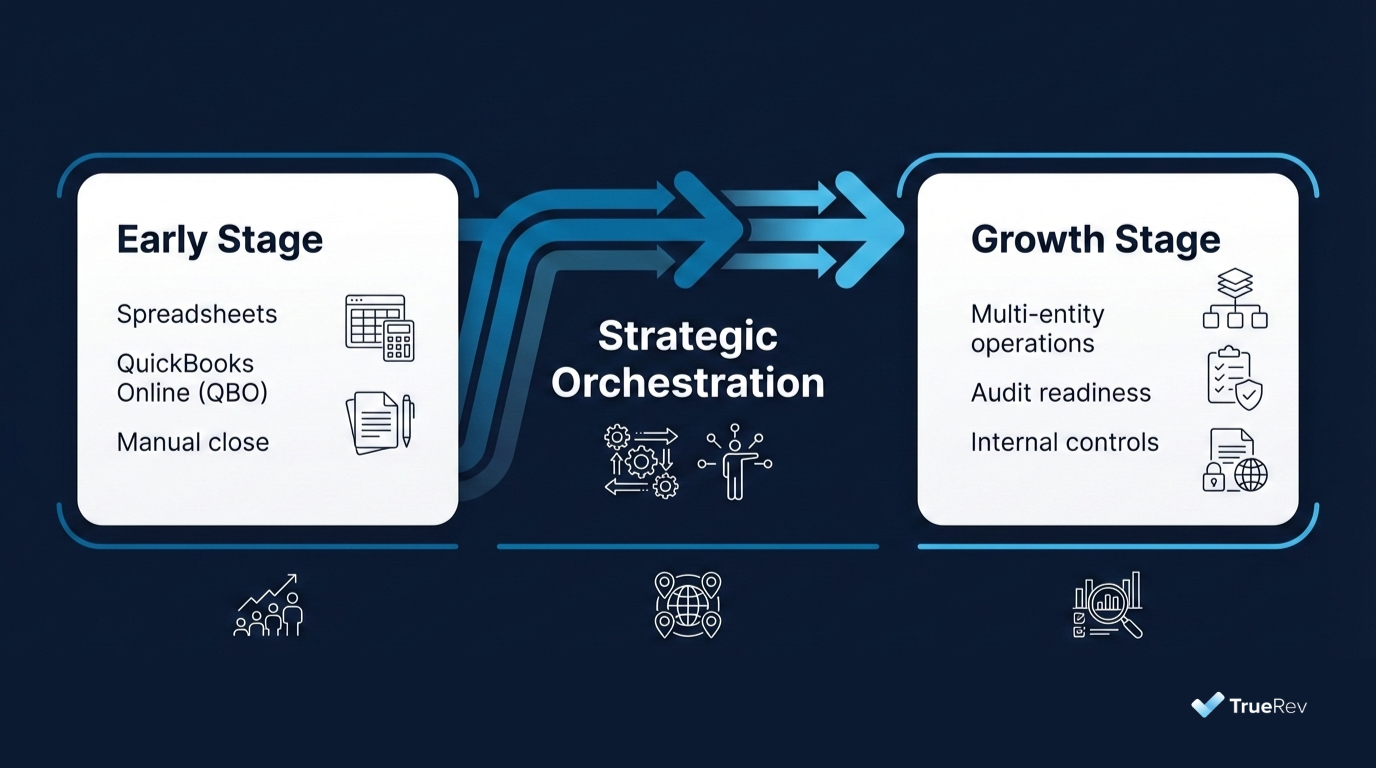
Comparing finance tools for a growth-stage SaaS company? See how the options fit different stages and requirements.
Frequently asked questions
Not always. Some platforms, such as Subscript, generate schedules from their own billing data. Others, such as TrueRev, work from your accounting system, QuickBooks Online. The right choice depends on where your contracts and invoices live today.
Subscript does not state a company-size limit. Its published price range starts at $15,000 a year, and G2 reviewers include both small businesses and mid-market companies.
TrueRev's pricing page lists a 14-day trial with all features. Subscript's public site directs buyers to request a demo, and we did not find a self-serve trial there.
TrueRev has not published a fixed timeline. Setup starts by connecting QuickBooks Online, then depends on your contracts and revenue recognition rules. Book a demo and we will walk through what it would involve for your setup. Subscript states that onboarding takes weeks, not months, with its team doing the heavy lifting.
You configure revenue recognition rules in TrueRev, and one customer with a very unusual policy describes it as flexible (see the customer quotes above). Bring your policy to a demo and we will show how it would be set up.
See if TrueRev is the right Subscript alternative for your team
If your team uses QuickBooks Online and primarily needs revenue recognition, deferred revenue, contract workflows, scheduled invoicing and SaaS metrics, see whether TrueRev gives you the finance layer you need without adding billing infrastructure you do not.
Starting at $299/month billed annually.